Reading Log Printable
A reading log turns reading into a habit you can see. This printable pack has logs for every age — simple daily minute trackers for young readers, weekly logs with a space for a parent or teacher signature, book review sheets, a 100-book challenge tracker, a reading bingo card and an Excel log that adds up your minutes, pages and books automatically.
Reading Log Printable Pack
Daily, weekly and monthly reading logs, book review sheets, a 100-book tracker, reading challenge bingo and an Excel reading log with automatic totals.
- Daily log (PDF/DOCX)
- Weekly log (PDF/DOCX)
- Book review (PDF/DOCX)
- 100-book tracker (PDF)
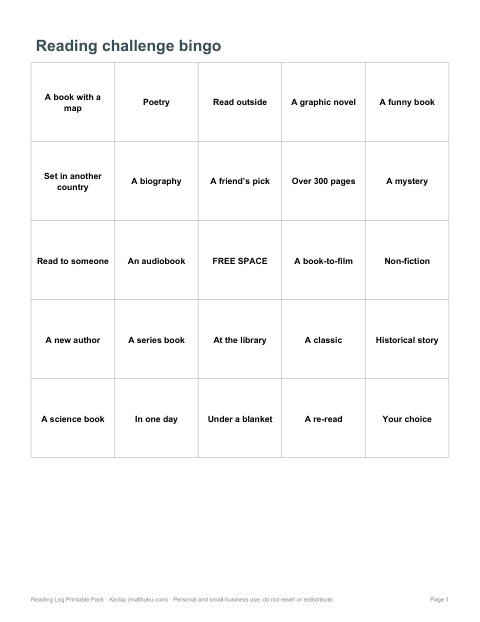
- Reading bingo (PDF)
- Excel log (XLSX)
Formats: PDF, DOCX, XLSX. Instant download after payment (link valid 72 hours, up to 5 downloads). AI-assisted: the templates were drafted with AI help and reviewed and laid out by Kedop.
$5.00 USD, one-time
Secure card checkout by Stripe. Full refund within 7 days — see the refund policy and license.
Reading logs in the pack
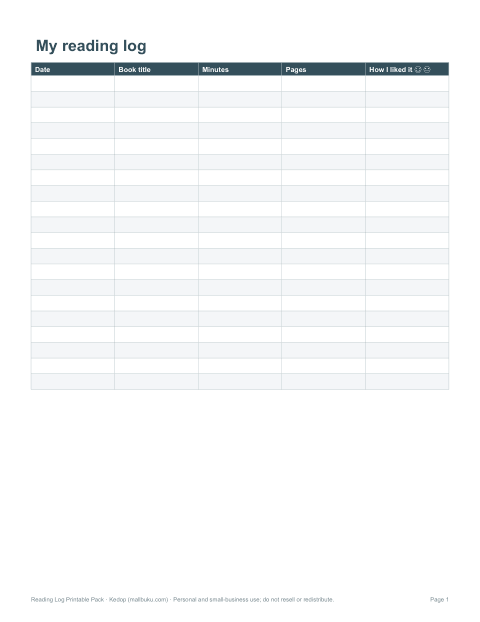
- Daily reading log — date, title, minutes and pages, with a smiley rating.
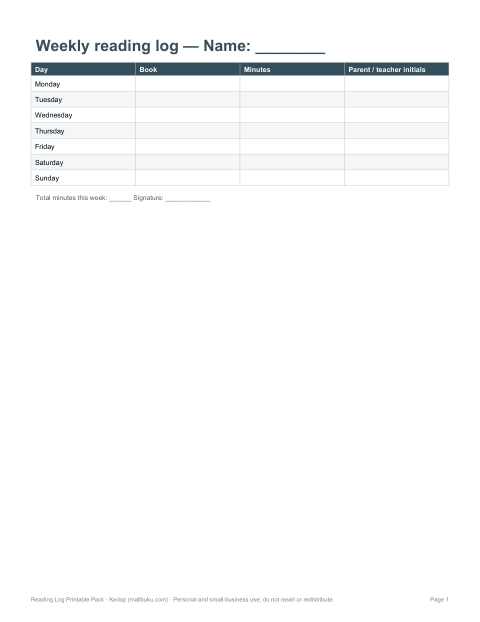
- Weekly log with signature — seven days on one page for school homework.
- Monthly calendar log — colour in a square for each day you read.
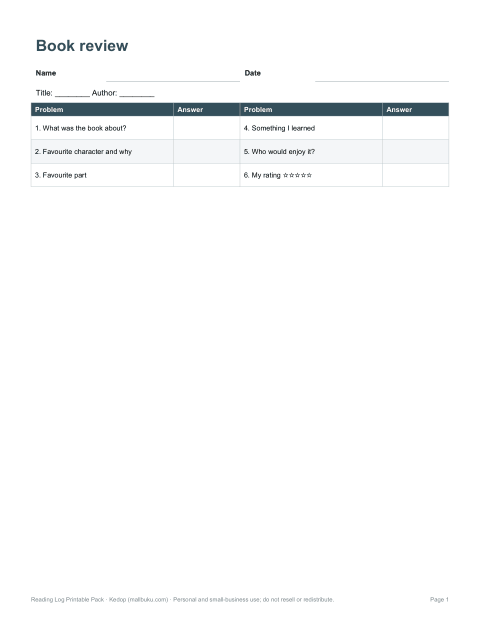
- Book review sheet — title, author, favourite part, characters and a star rating.
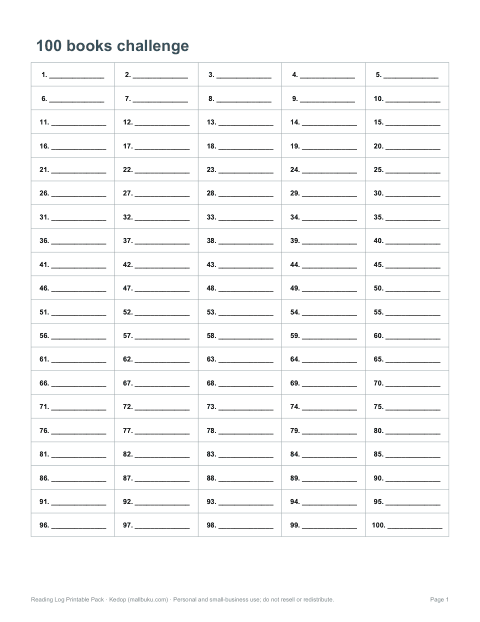
- 100-book tracker — a grid of 100 spines to fill in.
- Reading challenge bingo — 25 squares such as “a book with a map” or “read outside”.
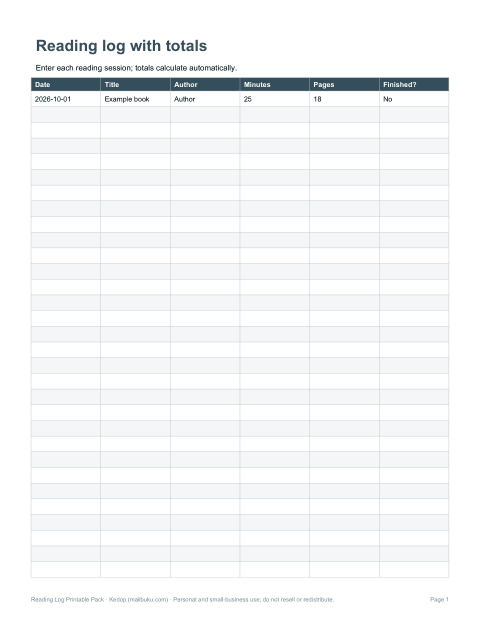
- Excel reading log — totals minutes and pages per week and month.
Choosing the right log
| Reader | Best log | Why |
|---|---|---|
| Early readers (4–7) | Monthly calendar or colouring log | Simple and visual; celebrates every day |
| Primary school (7–11) | Weekly log with signature | Matches most homework reading routines |
| Teens | Book review sheet and bingo | Encourages variety and reflection |
| Adults and book lovers | 100-book tracker and Excel log | Big goals and statistics |
| Classrooms | Weekly log plus challenge bingo | Easy to check and motivating |
How much reading is enough?
Many schools ask younger children to read for about 15–20 minutes a day and older pupils for 20–30 minutes. Research on reading for pleasure consistently links regular reading with stronger vocabulary and comprehension. The most important thing is consistency and enjoyment — ten happy minutes a day beats an hour of reluctant reading once a week.
Making logs motivating
- Let children choose what they read — comics, magazines and audiobooks count.
- Celebrate milestones: 10 books, 1,000 minutes, a full bingo line.
- Keep the log where the reading happens — by the bed or the sofa.
- Read together and log shared books too.
- Avoid turning the log into a chore: tick boxes, don’t write essays.
Reading logs for reluctant readers
For a child who resists reading, keep the log light. Count every kind of reading — recipes, instructions for a game, comics, subtitles, a football magazine — and focus on streaks rather than totals. A sticker for each day read, or colouring a square on the monthly calendar, gives quick rewards. Short sessions of five to ten minutes are fine at first; many children read longer once the habit is set and they find books they genuinely enjoy.
Using logs in the classroom
Teachers often send the weekly log home on Monday and collect it on Friday. Keeping the columns simple — title, minutes and an initial — makes it quick for families to fill in. The book review sheet works well as a short weekly written response, and a class reading bingo card can run for a half term, with a small celebration for every completed line.
Using the Excel reading log
Enter the date, title and minutes (and pages if you like) each time you read. The workbook totals minutes and pages automatically, so you can see weekly and monthly progress at a glance. It works in Excel, Google Sheets and LibreOffice, and prints neatly if a teacher needs a paper copy.
Reading challenge ideas
| Challenge | Examples |
|---|---|
| Variety | A poetry book, a graphic novel, a biography, a book in translation |
| Places | Read in the garden, on a train, at the library |
| Connections | A book a friend recommended, a book that became a film |
| Stretch | A book over 300 pages, a classic, a genre you’ve never tried |
Formats and printing
All logs print on US Letter or A4. Word versions let teachers add a class name or change the questions; the Excel log calculates totals automatically.
AI-assisted content
Templates were drafted with AI assistance and reviewed by Kedop.
Frequently asked questions
What is included in the reading log pack?
Daily, weekly and monthly logs, book review sheets, a 100-book tracker, reading bingo and an Excel log.
Is there a log with a parent signature?
Yes, the weekly log has a signature line.
Can I edit the logs?
Yes, Word and Excel versions are included.
Are the logs suitable for adults?
Yes, the 100-book tracker and Excel log suit adult readers.
What paper size are they?
US Letter, and they fit A4.
Is this a subscription?
No, it is a one-time download.
Do audiobooks count on a reading log?
Many teachers count audiobooks and shared reading; check your school’s expectations.